Chasing the Energy of Empty Space: Tesla's Tower, Searl's Rings and Bedini's Bench
"Throughout space there is energy," Nikola Tesla told a London audience in 1892. Three inventors spent their lives on that idea: a tower on Long Island, a ring of spinning magnets in England, and a pulse motor on an American workbench. This is a record of what they built, what they described and what they reported.
In February 1892 Nikola Tesla stood before the Institution of Electrical Engineers in London and put a question to the room. "Throughout space there is energy," he said. "Is this energy static or kinetic? If static our hopes are in vain; if kinetic—and this we know it is, for certain—then it is a mere question of time when men will succeed in attaching their machinery to the very wheelwork of nature."
That sentence has travelled a long way. For more than a century, inventors working in big laboratories and small garages have tried to attach their machinery to that wheelwork. Three names come up more than any others: Tesla himself, the British inventor John Searl, and the American experimenter John Bedini. What follows records what each of them built, described and claimed, and what others reported.
The tower on Long Island
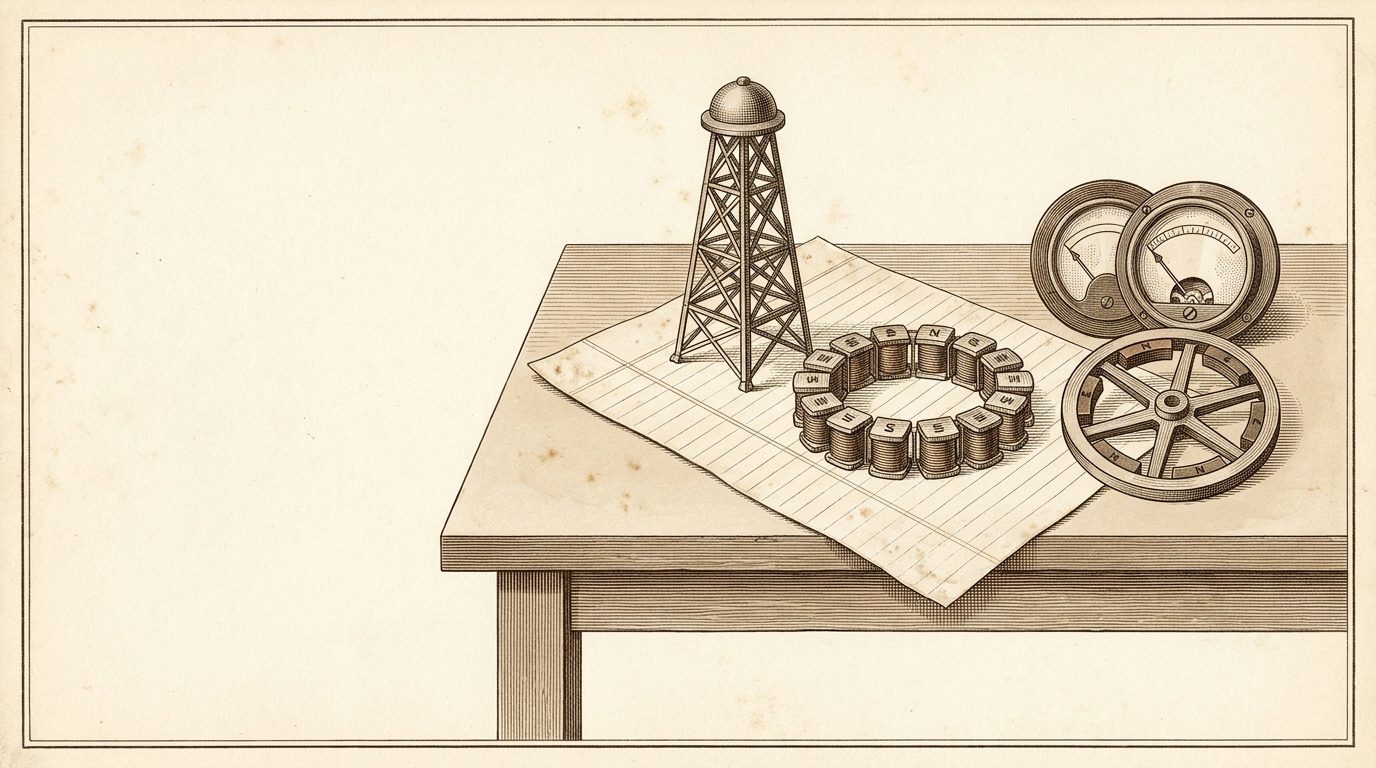
Tesla's work began with the coil. In 1891 he demonstrated the resonant transformer that still carries his name: an air-cored coil that produces high-voltage, high-frequency current and throws long sparks. In 1899 and 1900 he built a larger three-coil version, which he called a magnifying transmitter, at a laboratory in Colorado Springs.
In March 1901 the financier J. P. Morgan agreed to put $150,000 into a wireless station, in exchange for a 51 percent share of the venture and its related patents. Construction began that September at Shoreham, on Long Island. The brick laboratory was designed by the architect Stanford White, and by the end of 1902 the tower stood 187 feet tall. It was meant to send messages, telephony and images across the Atlantic and to ships at sea. Tesla also planned for it to transmit power itself, using the earth as the conductor.
The station was never completed. Tesla's plans grew larger, Morgan declined to put in more, and in December 1901 Marconi's transatlantic signal drew investors elsewhere. Work stopped in 1906 before the station ever went into service, and the tower was dynamited in 1917 after the property passed to creditors. The site endures: a public crowdfunding campaign helped buy it in 2013 for what is now a science center, and it was added to the National Register of Historic Places in 2018.
Later energy researchers often cite Wardenclyffe and Tesla's words about the wheelwork of nature as a starting point for their own work.
The rings and rollers
John Searl was a British electrician and inventor, born in 1932. His principal work was a machine he called the Searl Effect Generator: a stationary ring of magnetized material, circled by magnetic rollers. Searl said that once set in motion, the generator would keep turning and produce electricity without fuel. He and his supporters also said early versions rose into the air and cooled the space around them.
Searl's accounts of his first experiments go back decades. He said his working generators were later lost or seized. In Russia, V. V. Roschin and S. M. Godin published a report on a converter built to Searl's principles, describing magnetic and weight effects and an output of up to 7 kW. We found no published independent replication of that report. Searl kept working on the design for the rest of his life, and is reported to have died in 2018.
The garage bench
John Charles Bedini was an American inventor and experimenter, born in Glendale, California, in 1949, who died in November 2016. Among energy hobbyists he is best known for a pulse motor nicknamed the School Girl, or SG. It is a wheel of magnets, a coil and a transistor circuit, built to charge one battery from another. Published handbooks carried the design to builders around the world.
Bedini and his followers said his machines returned more charge to their batteries than they drew. We found no published independent test of that claim. He also held patents on battery-charging circuits. His designs were taken up by a large community of builders who wound their own coils and shared their results.
The energy of empty space
The idea underneath all three stories is also a concept in physics. Quantum mechanics says no system can ever be perfectly still. Even at its lowest possible energy, its ground state, something keeps moving. That leftover energy is called zero-point energy, and quantum field theory says empty space itself carries it: the vacuum is never truly empty.
It has measurable effects. In 1948 the Dutch physicist Hendrik Casimir predicted that two uncharged metal plates set very close together would be pushed toward each other by the energy of the vacuum around them. In 1997 Steve Lamoreaux measured that force in the laboratory, and later experiments have refined it. Many in the free-energy movement describe machines like Searl's and Bedini's as drawing on this energy of space.
Where the record stands
Tesla's tower was demolished in 1917, and the site is now a museum dedicated to his work. Searl's generator design and Bedini's SG continue to be built by independent experimenters. The three men worked decades apart and on different machines. What they shared was the premise Tesla stated in London in 1892: that there is energy throughout space, and that machinery might one day be attached to it.
Sources
- Nikola Tesla, "Experiments with Alternate Currents of High Potential and High Frequency," lecture before the Institution of Electrical Engineers, London, February 1892; text in T. C. Martin, The Inventions, Researches and Writings of Nikola Tesla (1894), chapter XXVII (Project Gutenberg ebook 39272). Source of the opening quotation.
- Wikipedia, "Wardenclyffe Tower" (construction 1901 to 1902, the Morgan contract, work stopped 1906, demolition 1917, the 2013 purchase, National Register listing 2018). Primary sources to cite before publishing: Tesla Science Center at Wardenclyffe, and the National Register nomination.
- Wikipedia, "Tesla coil" (1891 demonstration, Colorado Springs magnifying transmitter 1899 to 1900).
- Wikipedia, "Zero-point energy" (definition, vacuum energy, the Casimir prediction of 1948, experimental confirmation).
- S. K. Lamoreaux, "Demonstration of the Casimir force in the 0.6 to 6 μm range," Physical Review Letters 78, 5 (1997); erratum PRL 81, 5475 (1998).
- John Searl: Kook Science wiki entry and secondary accounts.
- V. V. Roschin and S. M. Godin, experimental report on a magnetic converter.
- John Bedini: obituary, Coeur d'Alene Press, 9 November 2016 (cdapress.com); patent listings under John C. Bedini; Bedini SG: The Authorized Beginner's Handbook.
