
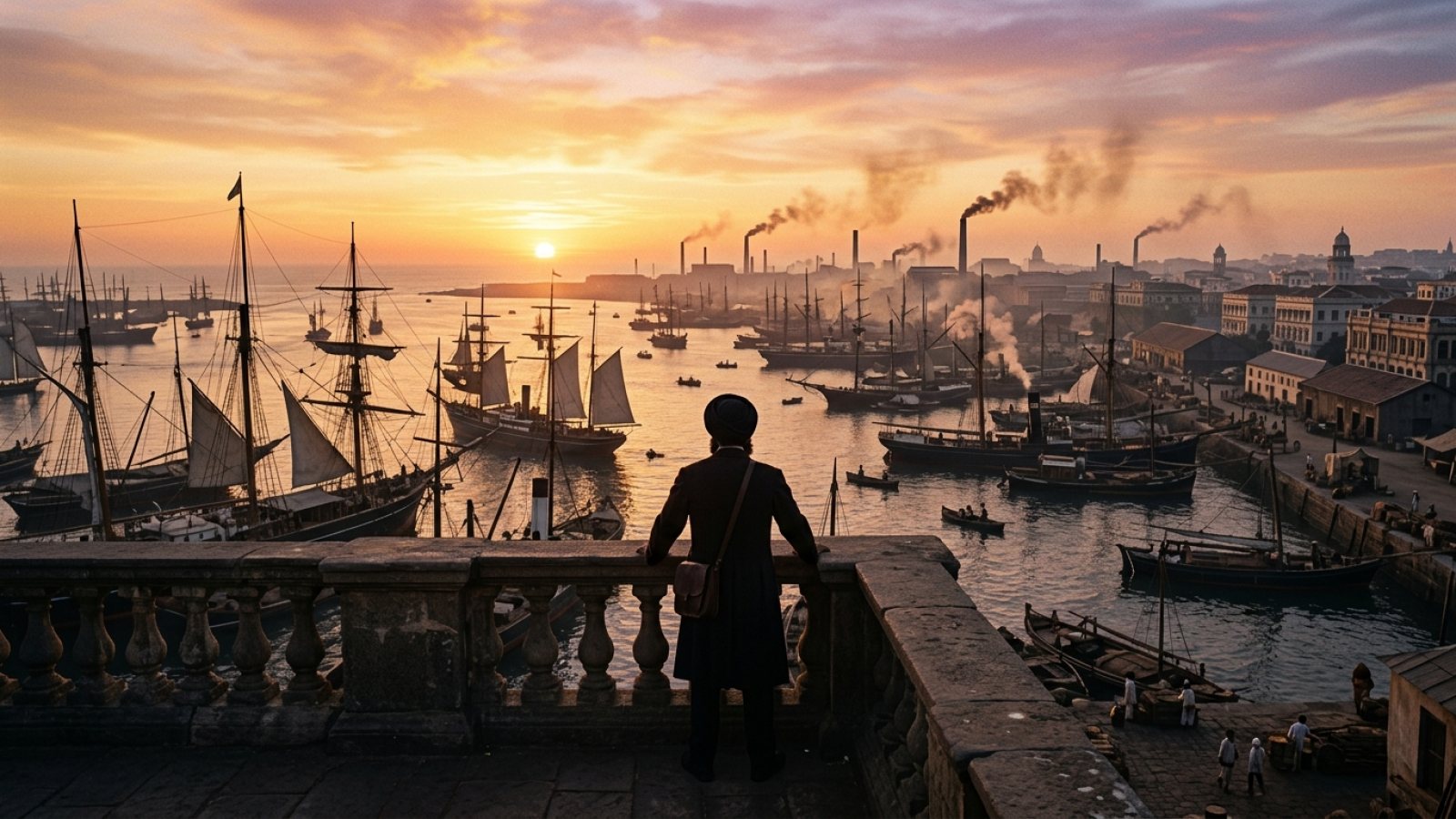
Jamsetji Tata: From Bombay Trading to India's Industrial Dawn
Jamsetji Nusserwanji Tata saw beyond the lucrative trade of 19th-century Bombay, envisioning an India forged in steel and powered by its own rivers. This is the story of a merchant who became a nation-builder, laying the foundations for an industrial giant.
In the bustling, ambitious port city of Bombay in the late 19th century, amidst the clatter of carts and the vibrant commerce of the British Empire, a young merchant named Jamsetji Nusserwanji Tata arrived from his native Navsari, Gujarat, in 1858. His father, Nusserwanji Tata, had built a respectable trading business, but Jamsetji harbored a vision far grander than mere trade: he dreamed of an industrialized India, self-sufficient and thriving. This ambition would lead him to risk everything on projects that would become the very backbone of a nascent nation.
Jamsetji’s entrepreneurial journey began with his family’s trading firm, where he quickly demonstrated a keen intellect for business. His first major independent venture came in 1868, purchasing a defunct oil mill in Chinchpokli, Bombay, which he then converted into a cotton spinning mill. After selling this venture for a profit two years later, he founded the Central India Spinning, Weaving, and Manufacturing Company in 1874. The crown jewel of this endeavor, the Empress Mills, opened in Nagpur in 1877, the same year Queen Victoria was proclaimed Empress of India. Here, Tata revolutionized not only industrial production but also employee welfare, long before such concepts were widespread. He introduced provident funds, accident compensation, and even creches for the children of his female workers – a testament to his belief that enterprise and social responsibility were inextricably linked. He meticulously studied modern manufacturing techniques, travelling to the mills of Manchester, England, to learn best practices and bring them back to India.
Forging a Nation: Steel and Electric Dreams
Despite the success of his textile ventures, Tata recognized India's profound dependency on imported industrial goods, particularly steel and electricity. He envisioned colossal projects: a steel plant to equip India with its own infrastructure, and hydroelectric power plants to fuel its cities and factories. These were monumental undertakings, demanding vast capital, advanced technology, and a belief in India's future that few shared, especially among the skeptical British colonial administration. For decades, he crisscrossed the globe, studying the steel mills of Pittsburgh, the hydroelectric dams of Niagara Falls, and the scientific institutes of Europe, meticulously gathering knowledge and seeking investment.
His search for a suitable location for a steel plant became legendary. He employed American metallurgists and geologists, such as Charles Page Perin, to scour the vast Indian subcontinent for the perfect confluence of iron ore, coal, and limestone. The task was daunting, fraught with logistical challenges and constant financial strain. What went wrong was primarily the sheer scale and difficulty of his ambitions; he faced constant resistance, resource scarcity, and the immense time required to bring such pioneering projects to fruition. He poured his personal fortune and reputation into these ventures, enduring setback after setback, often struggling to secure the necessary capital from a hesitant market.
A Legacy Cast in Iron and Light
Jamsetji Tata passed away in 1904 in Bad Nauheim, Germany, never seeing the completion of his two most ambitious dreams. Yet, his vision and meticulous planning had laid an unshakeable foundation. Just three years after his death, his successors founded the Tata Iron and Steel Company (TISCO) in Sakchi, a remote village that would later be renamed Jamshedpur in his honor. The first ingot of steel was rolled in 1912. Soon after, in 1910, the Tata Hydroelectric Power Supply Company was established, harnessing the monsoon rains of the Western Ghats to bring clean energy to Bombay by 1915. These enterprises not only supplied India with crucial industrial capacity but also became paragons of corporate governance and social responsibility.
What lasted is the enduring multinational conglomerate known as the Tata Group, built upon the principles Jamsetji established: pioneering industry, fostering scientific research (he also conceived the Indian Institute of Science), and prioritizing the welfare of employees and the nation. He understood that true wealth lay not just in profit, but in building the capacities of a people and a country. The story of Jamsetji Tata demonstrates that profound, lasting innovation often requires a steadfast belief in a future others cannot yet see, coupled with an unwavering commitment to the practical details of its construction.
