
Josiah Wedgwood: The Staffordshire Potter Who Sold to Queens and Everyone Else
In 18th-century England, Josiah Wedgwood transformed the humble craft of pottery into an industrial powerhouse and a global luxury brand. He pioneered techniques of production and marketing that continue to resonate with entrepreneurs today.
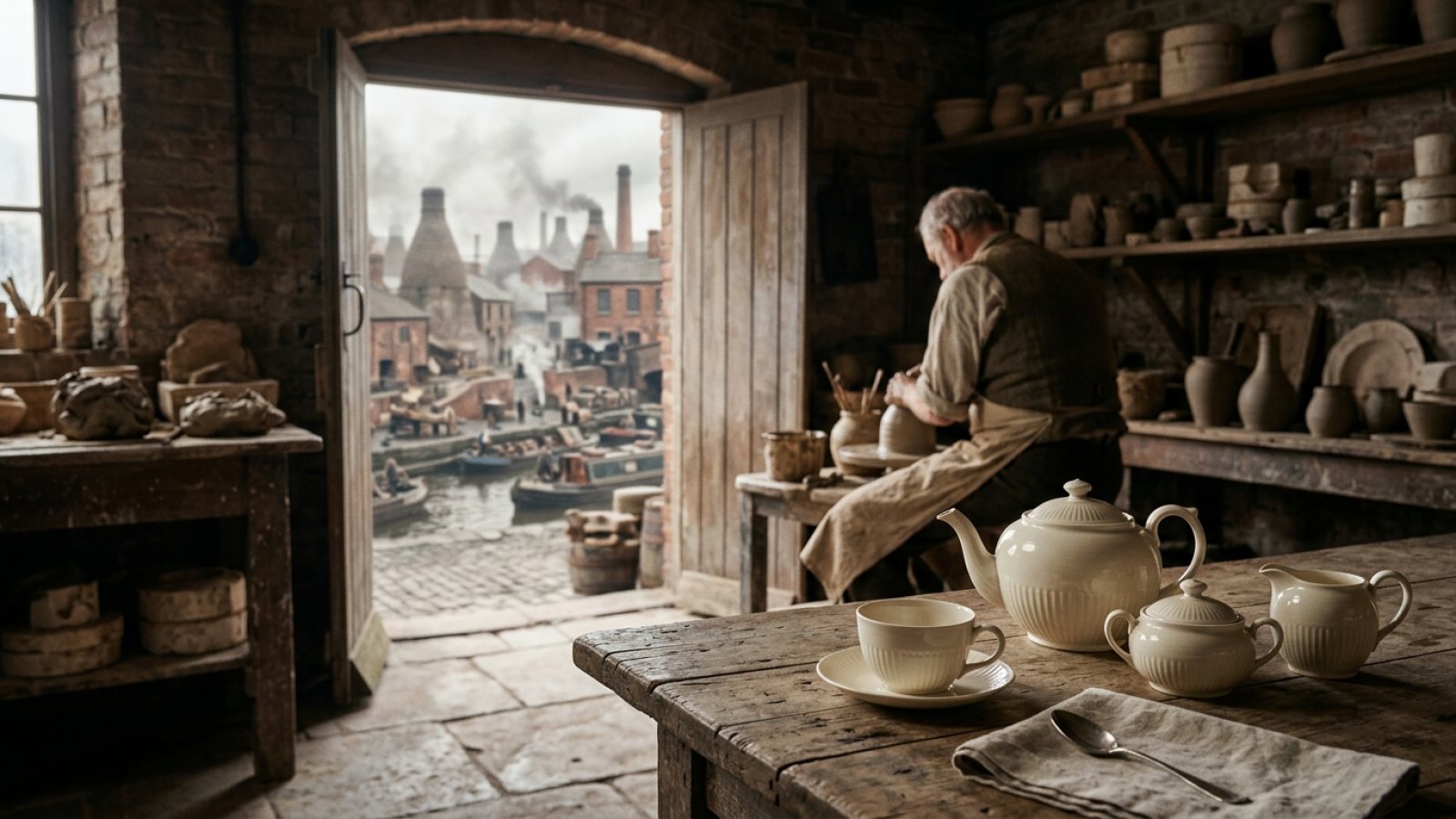
The damp, smoke-filled air of Burslem, Staffordshire, in the mid-18th century hummed with the industry of clay. Here, amidst the modest workshops and scattered kilns, a young Josiah Wedgwood, born into a long line of potters in 1730, was destined not merely to continue a trade, but to redefine it. From a childhood apprenticeship in his family’s small pottery, limited by a childhood bout of smallpox that made working the potter's wheel difficult, Wedgwood turned his keen mind to the chemistry of clay and the mechanics of commerce.
The Alchemist of Clay
Wedgwood's early career was marked by a restless pursuit of perfection and innovation. He partnered with several local potters, meticulously studying and experimenting with different clay bodies, glazes, and firing temperatures. His ambition was to elevate British pottery from rustic utility to a refined art form capable of competing with porcelain imported from China and Meissen. In 1759, at the age of 29, Wedgwood made the bold decision to establish his own business, setting up the Ivy House Works in Burslem. He risked his limited capital and reputation on the premise that meticulous craftsmanship, combined with scientific experimentation, could unlock new ceramic possibilities.
His breakthrough came with creamware, a durable and elegant earthenware that could be produced more affordably than porcelain. This light, refined pottery was a revelation, far superior to the coarse wares common in England. The turning point arrived in 1765 when Queen Charlotte, consort to King George III, ordered a tea service from Wedgwood. Delighted with the result, she granted him permission to style himself "Potter to Her Majesty" and to name his celebrated creamware "Queen's Ware." This royal endorsement was not merely an honor; it was a potent marketing tool that catapulted Wedgwood from a regional artisan to a national sensation, establishing his brand's prestige and desirability.
From Royal Decree to Mass Market
Wedgwood understood that royal patronage, while invaluable, was only one piece of the puzzle. He envisioned a market that spanned all strata of society, from emperors and empresses to the burgeoning middle class. He diversified his output, creating not only the luxurious "Queen's Ware" for dining tables across Europe but also durable and affordable utilitarian items for everyday use. His innovation extended beyond materials; he perfected the use of plaster molds, allowing for standardized production of complex designs, ensuring consistency and speeding up manufacturing.
He was a pioneer in marketing and distribution. Wedgwood opened a grand showroom in London, a bold move that brought his wares directly to a sophisticated clientele. He published illustrated catalogues, hired agents across Britain and continental Europe, and meticulously cultivated an export market, sending his pottery to America, Russia, and beyond. One of his most ambitious projects was the "Frog Service," a 952-piece dinner service commissioned by Empress Catherine the Great of Russia, each piece hand-painted with a unique British landscape. This colossal undertaking solidified his international reputation and demonstrated his capacity for mass-scale bespoke production.
Beyond "Queen's Ware," Wedgwood continued to innovate, developing Black Basalt, an unglazed stoneware resembling ancient Greek and Roman basalt carvings, and the iconic Jasperware, famous for its white classical reliefs on colored grounds, most notably pale blue. These sophisticated wares appealed to the Neoclassical tastes of the era, further cementing his reputation for artistic and technical excellence.
Building Etruria: A Vision of Industry
The success of his wares demanded greater production capacity. In 1769, Wedgwood undertook his most ambitious project: the construction of the Etruria factory and an accompanying village near Stoke-on-Trent. This was not just a workshop; it was a self-contained industrial complex, complete with canals for efficient transport of raw materials and finished goods, housing for workers, and an emphasis on clean, rational production. It was a substantial financial risk, requiring significant loans and a leap of faith in the future of industrial manufacturing. Etruria became a testament to his vision of integrated production, division of labor, and quality control.
The sheer scale of the enterprise brought its own challenges. Managing hundreds of workers, maintaining consistent quality across vast quantities of products, and navigating the complexities of international trade were constant pressures. Wedgwood was relentless in his pursuit of efficiency and improvement, always experimenting, always refining. His commitment to infrastructure extended to actively campaigning for the construction of the Trent and Mersey Canal, which ran directly through his Etruria site, dramatically reducing transport costs and transit times for his heavy and fragile products.
Josiah Wedgwood’s legacy is profound. He transformed pottery from a cottage industry into an industrial art, demonstrating how innovation in materials, production, and marketing could create a global brand. He showed that meticulous craft could coexist with mass production, and that entrepreneurship could shape both commerce and culture. What we can learn from Wedgwood is the enduring power of combining artistic vision with scientific rigor, and the courage to build an entire ecosystem around a singular idea.
