
The Spark of an Empire: Konosuke Matsushita and Osaka's Two-Way Socket
Konosuke Matsushita’s entrepreneurial journey began in a cramped Osaka tenement, driven by a simple idea for an improved electrical socket. From these humble origins, he would build one of the world’s most recognized electronics giants, Panasonic.
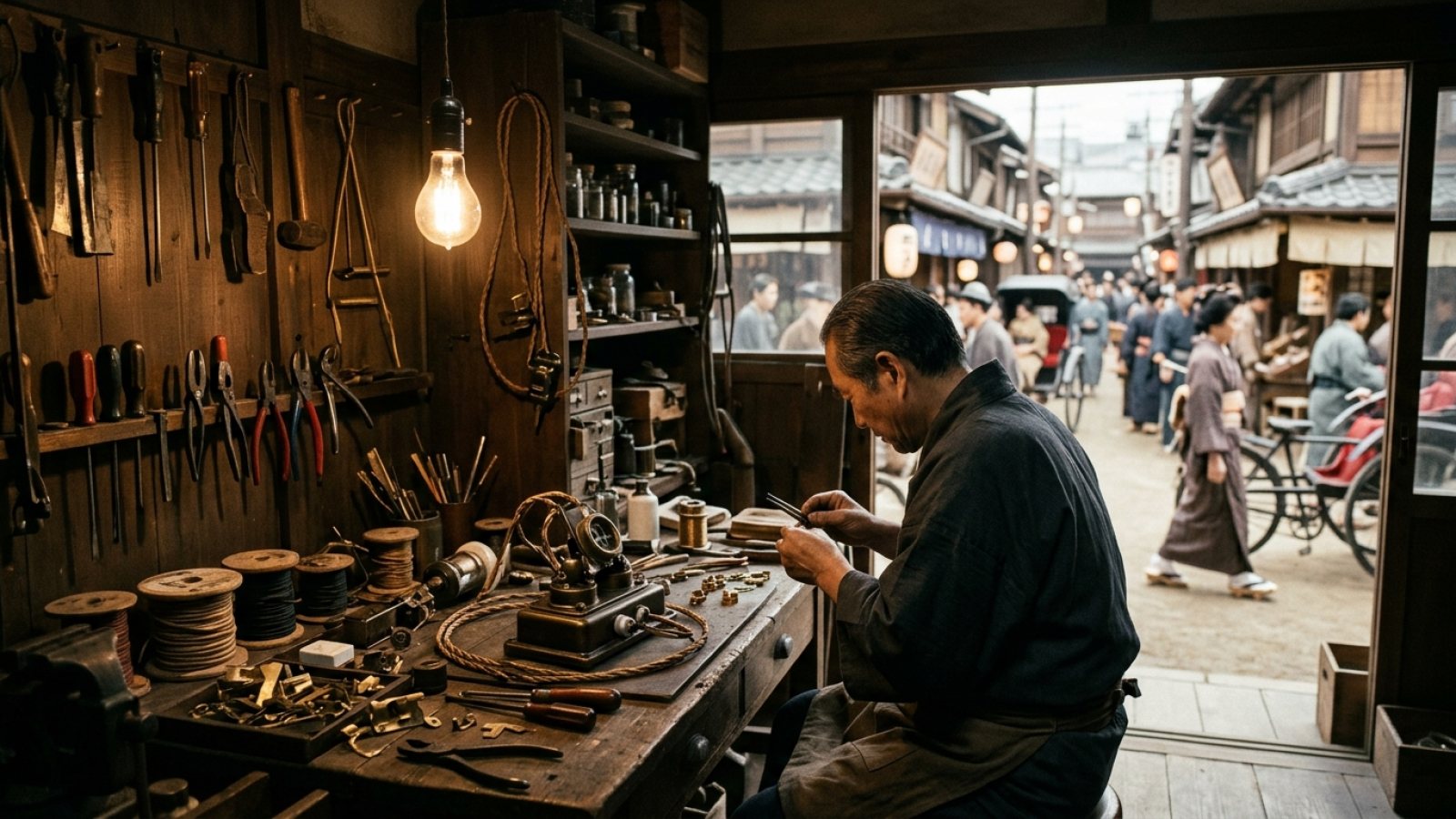
Konosuke Matsushita’s entrepreneurial journey began not with a grand vision of a global empire, but with a humble household frustration. In the bustling, rapidly modernizing city of Osaka, Japan, in 1917, the young technician, then just 22 years old and working for the Osaka Electric Light Company, observed a glaring inefficiency in the standard electrical fittings of the day. Homes often had a single ceiling light fixture, leaving residents to choose between illumination and powering another appliance. Matsushita conceived of a simple yet ingenious solution: an improved two-way light bulb socket, allowing a light bulb and an appliance to be powered simultaneously from the same fixture.
His supervisor, however, saw no market for such an item, dismissing the idea outright. Undeterred, and with a conviction that bordered on audacity, Matsushita decided to pursue his invention himself. He had endured a difficult childhood marked by poverty and illness, leaving school early to work as an apprentice in a bicycle shop and later in an electrical wiring firm. This early experience instilled in him a profound appreciation for practical utility and the resilience to face adversity. In 1917, with just 100 yen in savings—a substantial sum for him, and effectively all he possessed—he resigned from his stable job and, with his wife, Mumeno, and a couple of friends, established his own small workshop in a cramped, two-room tenement house on Urashio Street in Osaka.
Building a Foundation of Trust
The initial months were fraught with difficulty. Matsushita and his small team tirelessly handcrafted the two-way sockets, painstakingly molding insulation material and assembling the brass components. They faced intense competition from larger, established manufacturers, and orders were scarce. Local retailers were skeptical of the unknown upstart, and the fledgling company teetered on the brink of collapse. It was a turning point born of necessity: to avoid bankruptcy, Matsushita began taking orders for custom insulators from an electric fan manufacturer. This crucial pivot provided a much-needed lifeline, bringing in enough capital to keep his core product, the two-way socket, alive.
With slightly more breathing room, Matsushita returned to his original vision, refining his products. His next innovation, an improved attachment plug, featured a more durable and safer design. Unlike competitors, Matsushita ensured his products were consistently high quality and sold at a fair price, directly addressing the common consumer frustration with unreliable electrical goods. He understood that trust, built on consistent quality and practical utility, was the most valuable currency. By 1918, he formally established Matsushita Electric Housewares Manufacturing Works, operating out of a larger, rented space in the Higashinoda district of Osaka. He instilled a philosophy that products should not only be well-made but also accessible and affordable to the average household.
The Dawn of "National" and Global Ambitions
The true breakthrough arrived with another everyday item: the battery-powered bicycle lamp. Traditional lamps of the era were notoriously unreliable, often failing after only a few hours of use. Matsushita’s version, launched in 1923, was revolutionary. It used a unique, square battery and a superior bulb design, offering up to 50 hours of illumination—ten times that of its competitors. Initially met with resistance from wholesalers, who were unwilling to stock a product so radically different, Matsushita once again took an unconventional route. He sent samples directly to retailers, asking them to try it for themselves. The superior performance quickly won over shopkeepers and customers alike, and orders poured in. The "National" brand, adopted in the early 1920s for its accessibility and universal appeal, quickly became synonymous with dependable, affordable electrical goods across Japan.
The subsequent decades saw Matsushita Electric Industrial Co., Ltd. expand rapidly, producing radios, household appliances, and eventually televisions. Matsushita's business philosophy, often called the "tap water philosophy," proposed that manufactured goods should be as plentiful and inexpensive as tap water, ensuring widespread availability and affordability for society. The company faced immense challenges during World War II, when many factories were destroyed, and again during the post-war occupation. Yet, through these trials, Matsushita’s commitment to innovation and quality endured. The "Panasonic" brand, first introduced in 1955 for audio speakers and later adopted globally for a vast array of electronics, became the international face of the company built on that simple two-way socket.
A Legacy of Practical Innovation
Konosuke Matsushita led his company for over six decades, overseeing its transformation into one of the world's largest and most respected electronics manufacturers. While the sheer scale of the enterprise grew beyond anything imaginable in his tenement workshop, his core principles remained: a relentless focus on practical innovation, an unwavering commitment to quality, and a belief in the social mission of business to improve people's lives through affordable, useful products. He famously championed a holistic approach to business, emphasizing employee welfare, fair competition, and societal contribution alongside profit.
What lasted was not just a global conglomerate, but a philosophy of entrepreneurship that valued resilience, customer insight, and an ethical approach to commerce. Matsushita’s story teaches us that true innovation often stems from a keen observation of everyday needs, and that enduring success is built not just on groundbreaking inventions, but on a steadfast commitment to quality and a clear understanding of practical utility.
