
The Merchant Revolution of Mitsui Takatoshi: Cash, Fixed Prices, and the Birth of Modern Retail in Edo
In the bustling city of Edo, 17th-century Japan, Mitsui Takatoshi challenged centuries of mercantile tradition, introducing radical concepts like cash-only sales and fixed pricing. His dry goods store, Echigoya, didn't just sell fabrics; it laid the groundwork for modern consumer retail.
In the bustling metropolis of Edo, 17th-century Japan, a radical idea took root that would redefine retail and commerce for centuries to come. It wasn't born in a gilded palace or a scholarly debate, but in the practical mind of a merchant named Mitsui Takatoshi. In an era dominated by credit, haggling, and cumbersome bartering, Takatoshi proposed a simple yet revolutionary concept: cash sales and fixed prices. His dry goods store, the Echigoya, was not just a shop; it was a blueprint for modern consumer retail, challenging centuries of established practice and laying the foundation for one of Japan's greatest corporate dynasties.
From Matsusaka to the Streets of Edo
Mitsui Takatoshi's journey began not with textiles, but with sake. Born in 1622 in Matsusaka, Ise Province, into a family that had brewed sake and soy sauce for generations, Takatoshi grew up immersed in the rhythms of trade. While his elder brothers continued the family business, Takatoshi developed a keen eye for opportunity. He observed the inefficiencies of the traditional mercantile system: extended credit meant delayed payments and bad debts; price negotiations were time-consuming and often unfair, benefiting only those with the strongest bargaining position or best connections. He saw a gap for transparency and efficiency, a market for convenience that no one else was addressing. By the 1670s, he had sold off the family brewing interests and moved into the textile trade, identifying a burgeoning market among Edo's rapidly growing merchant and samurai classes.
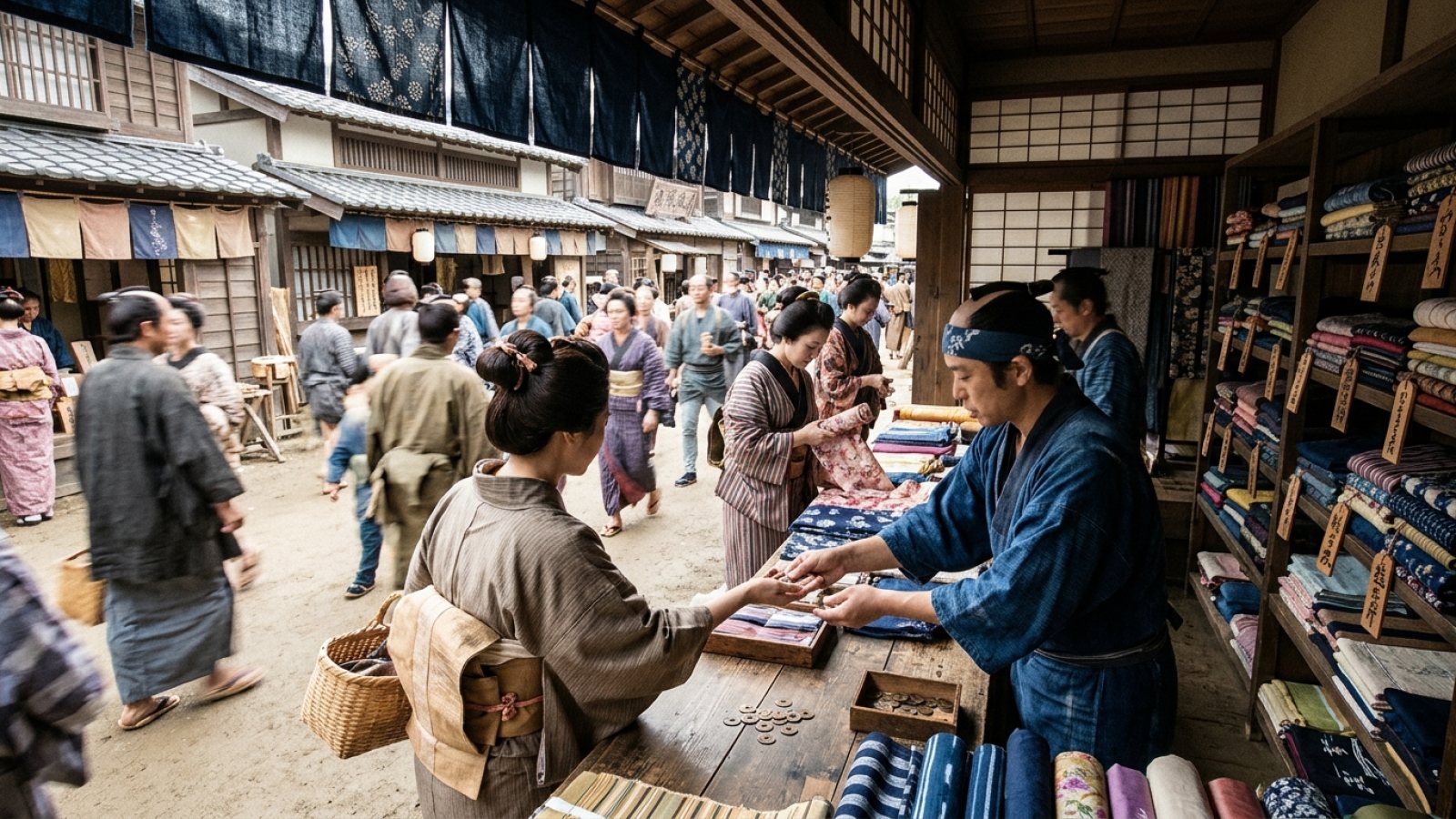
In 1673, Takatoshi opened the first Echigoya dry goods store in the Nihonbashi district of Edo, a bustling commercial heartland. His innovative business model was starkly simple: 'cash on the nail, no credit given,' and 'one price for all, no haggling.' This was a seismic shift. Previously, merchants would extend long credit terms, often inflating prices to account for the risk and the time value of money. Customers would spend hours, sometimes days, negotiating a fair price. Takatoshi, by contrast, offered clearly marked, fixed prices that were significantly lower than his competitors' starting points, because he eliminated the costs associated with credit risk and lengthy sales processes. His stores sold high-quality kimono fabrics, and later, ready-to-wear garments, directly to customers who could pay immediately. The speed of transaction allowed for higher sales volume and quicker capital turnover, a powerful advantage.
The Radical Logic of Cash and Fixed Prices
The Echigoya wasn't just about speed; it was about trust. In an opaque market, Takatoshi offered transparency. His prices were known, his quality consistent. He also introduced the practice of offering fabrics cut to precise lengths, a departure from the traditional selling of entire bolts, making goods accessible to a wider range of customers, from wealthy samurai to aspirational townspeople. This focus on customer convenience and fair dealing quickly earned the Echigoya a reputation for reliability and value. While established merchants scoffed at his 'uncivilized' practices, the sheer volume of customers flocking to Echigoya proved Takatoshi right. His model demonstrated that lower margins on high volume could generate far greater profits than high margins on slow, credit-based sales.
Building an Empire Beyond Fabric
Takatoshi’s success in textiles led him to another innovative venture: banking. With the large sums of cash generated by Echigoya, he began offering money exchange services and remittances, allowing merchants to transfer funds between Edo and Kyoto without the physical risk of carrying specie. This service, initially a convenience for his textile customers, evolved into a full-fledged financial institution, laying the foundation for what would become the Mitsui family's immense wealth and power. The Mitsui Exchange House became a pillar of Japan's burgeoning economy, eventually transforming into the modern-day Mitsui Group, a conglomerate spanning banking, trading, and industry.
What started as a modest dry goods store in 17th-century Edo evolved into a commercial empire, all because Mitsui Takatoshi dared to challenge convention. He understood that convenience, transparency, and a focus on the customer could unlock unprecedented value. His innovations—cash sales, fixed prices, and a relentless pursuit of efficiency—were not merely clever tricks; they were fundamental shifts that streamlined commerce, empowered consumers, and provided a blueprint for the modern retail and financial systems we recognize today. The lesson from Echigoya is clear: sometimes, the most revolutionary ideas are the simplest, those that prioritize clarity and directness in a complex world.
