
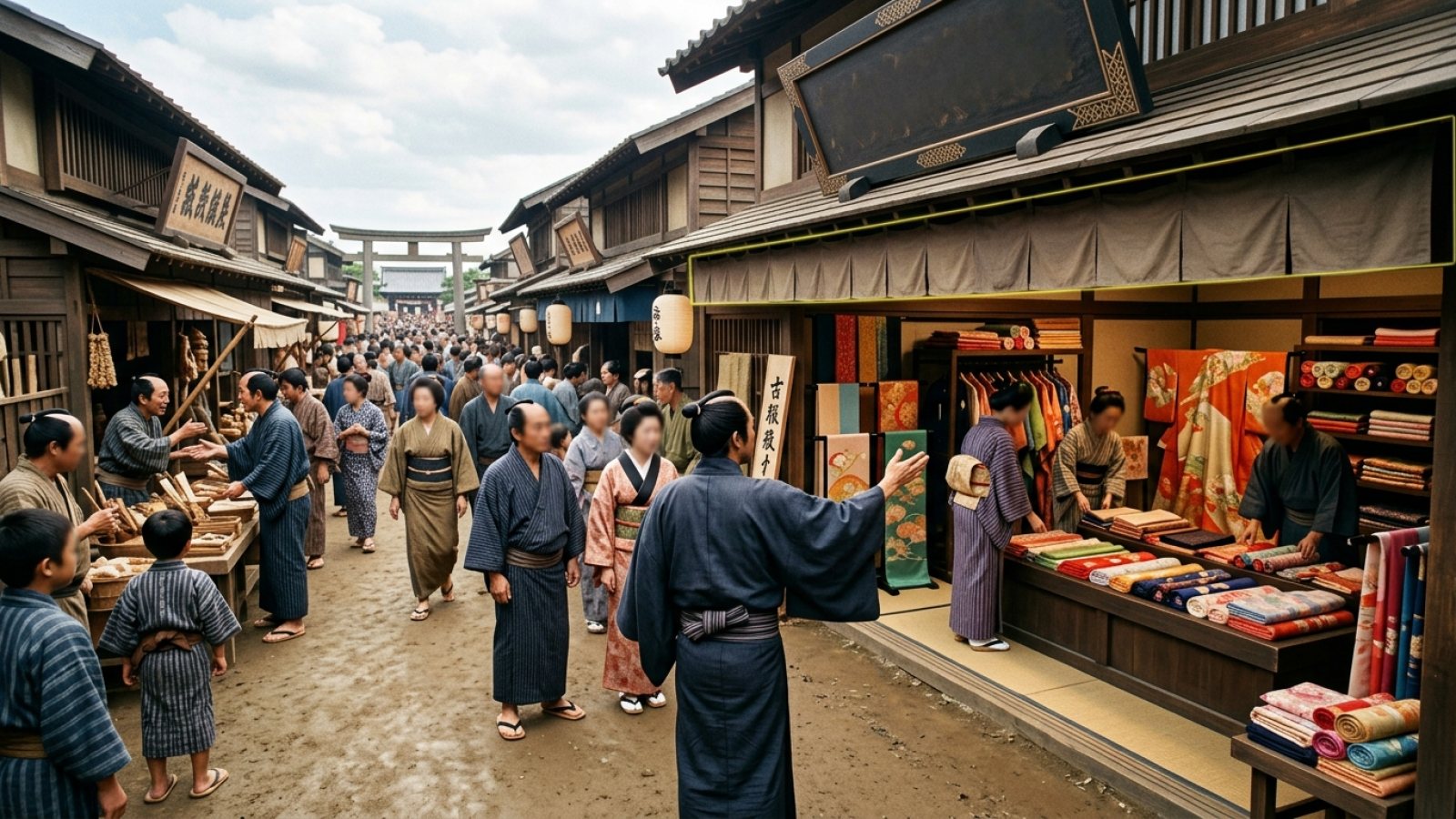
In the vibrant, sometimes chaotic, heart of Edo in 1673, a revolutionary idea took root, quietly challenging the very foundations of commerce in Japan. Mitsui Takatoshi, a merchant with an astute mind and a daring vision, opened the doors of Echigoya, a dry goods store that would not only sell exquisite kimonos and fabrics but also rewrite the rules of trade for centuries to come.
The Old Ways and a New Vision
For centuries, Japanese commerce, particularly among established merchants, operated on a system of protracted credit and elaborate haggling. Customers, especially those of means, often received goods on account, settling balances months later, sometimes even a year. Prices were fluid, negotiated individually with each purchase, a time-consuming ritual that demanded patience and shrewdness from both seller and buyer. This opaque system often led to financial uncertainty for merchants, who carried significant risk with extended credit, and limited access for ordinary citizens who lacked the connections or patience for such transactions. Mitsui Takatoshi, born in 1622 in Matsusaka, Ise Province, emerged from a family with a strong background in sake brewing and pawnbroking. His mother, Mitsui Take, a formidable businesswoman in her own right, instilled in him an early understanding of financial prudence and the value of direct customer engagement. Observing the inefficiencies, the inherent risks, and the exclusive nature of the prevailing credit system, Takatoshi envisioned a different, more transparent, and ultimately more democratic path for commerce.
The Echigoya Revolution
When Echigoya opened its doors in 1673 on Honcho Street in Edo's bustling Nihonbashi district, it was nothing short of a commercial bombshell. Takatoshi introduced two groundbreaking policies that directly confronted centuries of tradition: fixed prices and cash-only sales. For the first time, customers knew exactly what they would pay for a kimono or a length of exquisite fabric, without the need for tiresome negotiation. This radical transparency, a stark contrast to the opaque bargaining that dominated the market, offered a sense of fairness and respect to every buyer. Furthermore, by demanding immediate payment in cash, Echigoya eliminated the substantial financial risks and complex administrative burden associated with extending credit. This allowed Takatoshi to operate with greater efficiency, achieve faster inventory turnover, and, crucially, offer significantly lower prices than his competitors. His strategy appealed directly to the growing class of common townspeople (chōnin) who sought quality goods at affordable rates and appreciated the straightforward transaction. Echigoya became a sensation, attracting a broad clientele eager for fairness and value. To further enhance customer convenience, Mitsui later pioneered direct home delivery services using a network of fast runners (hikyaku), an early and sophisticated form of last-mile logistics that extended the reach of his innovative retail model.
Growth and Lasting Legacy
The success of Echigoya was swift and undeniable, though it certainly faced initial resistance from entrenched merchants who saw their traditional advantages eroding. Its innovative model, initially met with skepticism, soon proved its commercial superiority, demonstrating the power of customer-centric strategies. Takatoshi rapidly expanded operations, opening additional branches in Edo and Kyoto, and shrewdly diversifying his enterprise into wholesale, textiles manufacturing, and eventually exchange banking, laying the formidable groundwork for what would become the vast Mitsui Group. He meticulously documented his business principles and management techniques, leaving behind a legacy of pragmatic innovation that emphasized efficiency, customer satisfaction, and fiscal discipline. Though he faced the inevitable challenges of managing a rapidly growing enterprise and ensuring stable succession within his large family, his core principles of fixed prices, cash sales, and direct customer engagement remained the bedrock of his expanding empire. These seemingly simple changes not only transformed retail in Japan but laid the foundation for modern commercial practices, including the department store concept and systematic supply chain management, centuries before their widespread adoption in the West. Mitsui Takatoshi didn't just sell goods; he sold a new way of doing business, built on trust, transparency, and efficiency that proved profoundly enduring.
Mitsui Takatoshi's story teaches us that true innovation often lies not in complex inventions, but in daring to question established norms and meticulously redesigning the customer experience. By prioritizing clarity, affordability, and convenience, he built an enduring empire that resonated deeply with the needs of his time, proving that a simpler, fairer transaction can be the most powerful business strategy of all.
